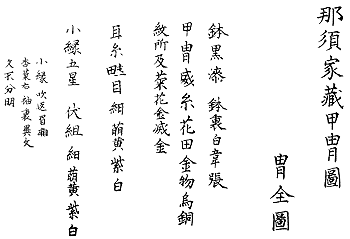
The upper text from the Shûko jisshu is cropped to the right.
|
CORRIGENDA & ADDENDA "Armures du Japon 100 pièces sélectionnées dans la collection de la Fondation Kôzu de Kyôto" Japanese Armour 100 Pieces selected from the collection of the Kôzu Foundation in Kyôto |
| Imprimer le document - Print I P.Précédente - Back |

| page 6, 84, 98: | Le “Kaden yoroi
ki“ date de 1858 et non de 1793. The “Kaden yoroi ki“ dates from 1858, not 1793. |
| page 9: | Le texte du haut
du Shûko jisshu est tronqué à droite. The upper text from the Shûko jisshu is cropped to the right. |
|
| page 23: | Casque de la branche
des Myôchin d’Odawara en Sôshû, possiblement Katsuie. The helmet is by a Myôchin of the Odawara branch in Sôshû, possibly Katsuie. |
| page 35: | Cuirasse de style
hotoke-dô en acier laqué noir. The cuirass is in black lacquered steel hotoke-dô style. |
| page 41: |
Il y a une erreur de frappe à la 2e
ligne: lire 1590 et non 1690. |
| page 42: | Des
recherches ont permis
d’identifier l’armoirie principale comme celle de la famille Takasu, karô de la branche des Sakai, daimyô
de Himeji en Harima 播磨國姫路酒井家の家老高須家紋. |
| page 45: | J’y ai mentionné
que le porteur de l’armure n’avait pu être déterminé, malgré le kiri-mon
en armoirie secondaire. Des recherches ont fourni une indication possible
de son identité : Katô Sado no kami Akihide 加藤佐渡守明英 (1652-1712) succède comme daimyô de Minakuchi en 1685 avec 20.000 koku. Il est nommé wakadoshiyori
(conseiller junior du bakufu,
un poste très élevé) en 1690 et transféré à Mibu en Shimotsuke 下野壬生 de 1695 jusqu’à sa
mort en 1712 avec 25.000 koku.
Ses successeurs reviennent, et resteront, à Minakuchi, Cette période
est cohérente avec celle de Neo Masanobu qui a fait le casque, ainsi
que l’usage du kiri-mon et le grand luxe de cette armure
avec son haut poste, auquel ses descendants ne succéderont pas. |
| page 53: | Les couvercles des
caisses de l’armure, sont montées d’origine de façon inhabituelle
avec des charnières de style occidental, ce qui confirme une fabrication
postérieure à 1853. The box covers are originally mounted in unusual fashion with Western style hinges, which confirms a making date after 1853. |
| page 55: | Le texte japonais
du haut est tronqué : The upper Japanese text is truncated: 長門國萩藩一門家老宍戸家傳来 |
| page 58: | Le
texte japonais du haut est tronqué : The upper Japanese text is truncated: 美濃國大垣藩主戸田家傳来 |
| page 62: | Il y a une erreur
dans la date: 6e mois et non 3e, et une erreur de kanji dans
"jour faste". There is a mistake in the date: 6th month not 3rd, and a wrong kanji in "lucky day". 永正十六年己卯六月吉日 |
| page 71: | Le kanji “kabuto”de
l’inscription manque dans le texte japonais. The kanji “kabuto” of the inscription is missing from the Japanese text. |
| page 80: | Les références
bibliographiques sont répétées deux fois. The bibliographical references are repeated twice. |
| page 87: | Les pièces
de fixation du nez du n° 68 sont en forme de deux colombes affrontées
stylisant le caractère “hachi 八” pour représenter le nom de Hachiman, dieu
de la guerre. The nose attachment pieces of n° 68 are shaped as two facing doves, a stylization of the character “hachi 八” to represent the name of Hachiman, god of war. |
| pages 96, 109 : | Remerciements au
Dr Alain Briot, pour sa lecture d’inscriptions difficiles. Thanks are owed to Dr Alain Briot for his reading of obscure inscriptions. |
| page 111: | Les coutures de renfort
de trois des anneaux représentent des signes auspicieux du onmyôdô (occultisme)
dont Abe no Seimei est un maître célèbre de l’époque Heian : 3 of the strenghening stitches represent auspicious signs of the onmyôdô (occultism) of which Abe no Seimei is a famous master from the Heian period: kuji  , Abe no Seimei han mon
  , kanau shirushi mon 叶
 |
| page 128: | Bibliographie :
« Bushi no bi (1994) » doit se lire « Mononofu no bi » et donc dans les pages Bibliography : « Bushi no bi (1994) » must be read « Mononofu no bi » and therefore in pages 9, 11, 13, 14, 17, 29, 31, 32, 35, 39, 41, 42, 43, 45, 53, 61, 62, 66, 70, 72, 73, 75, 76, 85, 93, 94, 96, 106 |
| page 128: | La bibliographie
doit être complétée ainsi que les références
des pièces suivantes: The bibliography is to be completed as well as the references of the following pieces: Nihon no mei yoroi ten, Ôsaka, Ôsaka-jô & Nihon keizai shinbunsha, 1964 n°4, p. 12 Kabuto hyaku-tô ten, Hiroshima, NKBKK, 1967 n°49 p.70, n°54 p.75, n°55 p.76, n° 56 p.77 Sengoku jidai no Kishû Saiga, Wakayama, Wakayama shiritsu hakubutsukan, 1988 n°50, p. 71 Shimazu Nariakira, Kagoshima, Kagoshima-ken rekishi shiryô center, 1988 n°42, p. 66 Musha gyôretsu, Kameoka, Kameoka-shi bunka shiryôkan, 1990 n°6 p. 14, n°16 p. 28, n°37 p. 59 Chûsei e no tabi, Utsunomiya, Tochigi kenritsu hakubutsukan, 1990 n°1, p. 9 Taiheiki no sekai ten, Tôkyô, NHK, 1991 n°49 p.70 Samazama naru ishô – Somekawa no bi, Yatsushiro shiritsu hakubutsukan, 1992 n°76, p. 95 Sengoku no gojûnin, Ôsaka, Ôsaka-jô tenshukaku, 1994 Hachisuka-ke no katchû, Tokushima, Tokushima-jô hakubutsukan, 1995 n°42, p.66 Ikoku no kaze (Winds from afar), Kyôto, Kyôto bunka hakubutsukan, 2000 n°74 p.94, n°78 p.98 Nihon bushô retsuden, Tôkyô, Shin jinbutsu ôraisha, 2007 n°33 p.52, n°54 p.75 KAZARI – Nihon bi no jônetsu, Tôkyô, NHK, 2008 n°38 p.60, n°54 p.75 Sengoku fashion – bushô no bigaku, Nagoya, Tokugawa Bijutsukan, 2009 n°54 p.75 |